Stark Battery Tech Thread

they said that "in most cases" it will be possible, but i dont know what they exactly mean by "in most cases"... they probably mean "in most models" i think... and the Varg should be one of those 🤞
They've also said that the Varg would get traction control, adjustable flywheel.
And editing power maps would come to MX1 😜
 
They've also said that the Varg would get traction control, adjustable flywheel.
And editing power maps would come to MX1 😜
yeah i know... they are so good at some things and terrible at others... the APP sucks... the new features of the "storage charging" and "adjustable brightness for the mapswitch" doesnt work for a month and a half since release day... We've also had the 6.6kW charging setting in the app for the last 5 months, but it's not usable... nonsense
 
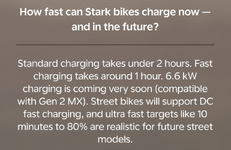
6.6kW charging will come 'soon' - but only for MX? I've asked elsewhere if it will be possible to parallel two Stark 3.3kW chargers, but they declined.
A 6.6kW charger will probably be as mobile as an MX tent.

1772600797231.png
 
I don't think that those new cells in the announced length will be in the Varg. It will end up much wider wich is an issue for a dirtbike. Or will end up much narrower. I could see the same chemistry and aluminium caps on the current cell size though.

It will have the drawback for them of having 2 kinds of cells. But that does seem manageable.

Edit: If that fast charging is compatible with MX 1.2 it will also do EX and SM. Exact same platform.
 
the current battery has some room to be a little wider on the front and bottom... but not on the part inside the frame, i dont know, just saying 🤣
 
6.6kW charging will come 'soon' - but only for MX? I've asked elsewhere if it will be possible to parallel two Stark 3.3kW chargers, but they declined.
A 6.6kW charger will probably be as mobile as an MX tent.

View attachment 16125
There are some photos on this forum of the 7kW Stark chargers, but I don't know where they are now... several of them were seen together at a motocross track. The chargers were almost identical to the original, just a little bigger.
 
I don't think that those new cells in the announced length will be in the Varg. It will end up much wider wich is an issue for a dirtbike. Or will end up much narrower. I could see the same chemistry and aluminium caps on the current cell size though.

It will have the drawback for them of having 2 kinds of cells. But that does seem manageable.

Edit: If that fast charging is compatible with MX 1.2 it will also do EX and SM. Exact same platform.
Pretty sure they would stick with one type of cells cause I don't see any advantage in carrying older cells once you have developed your own superior cells. 26120 will be first used for street bikes then trickle to Vargs.

Also don't think 26120 would end up with a wider pack for dirt bikes, see discussion on pages 2 and 3 in this thread.
Current pack is about 160 mm wide with 2 rows of 21700 cells, that is 140 mm wide of cells, cooled on only one end.
26120 cells will be 120 mm wide, cooled on both ends. If anything the 26120 pack could be a bit thinner.

For street bikes with higher capacity, sure they may end up using 2 rows of 26120 cells, more or less equivalent in width (likely a bit narrower) with the 2 Varg-ish packs (that is 4 rows of 21700 cells) seen in Royal Enfield Himalayan electric prototype but still probably better cooling.
 
Then you would need to assume that 1 row of the 120mm would do the same amount of power as 2 of 70mm.
If so that could mean a narrower battery pack. If not, nobody is gonna want a Varg that can get less far than the old one.

I would suspect they want the same width since they can keep the same frame, same plastics, same everything. That would outweigh having 2 types of cells i suppose.
I'm not saying they should stick to the old cells. More use the same tech in cells the same size.
 
Then you would need to assume that 1 row of the 120mm would do the same amount of power as 2 of 70mm.
If so that could mean a narrower battery pack. If not, nobody is gonna want a Varg that can get less far than the old one.
Yes I did this kind of calculations on page 2, I'll update here using Molicel P50B specs.
We don't know which 21700 5.0 Ah cells they use in the 7.2 kWh pack, just that they're not Molicel P50B but since we have to start somewhere, I used P50B specs which are state-of-the-art 5.0 Ah cells with gravimetric energy density of 260 Wh/kg and volumetric energy density of 714 Wh/l, giving a volumetric mass of 2.75 kg/l (or g/cm³).

For 26120 I used gravimetric energy density of 330 Wh/kg (which is their performance target), we don't know volumetric energy density nor volumetric mass so I made an assumption, using volumetric mass of 2.75 kg/l identical to P50B would give volumetric energy density of 908 Wh/l.

So to make a 7.2 kWh pack, as in Varg MX1.2/EX/SM, you could have either

400 21700 cells
total cell weight 27.7 kg
total cell volume 10.1 l

or

124-ish larger 26120 cells
total cell weight 21.8 kg
total cell volume 7.9 l

Of course there are uncertainties in this, in particular precise dimensions for the cells could play on overall volume and volumetric energy density is unknown (though with Molicel P60B given at 888-838 Wh/l, 900ish does not seem too unrealistic). Using Molicel P60B volumetric mass of 3.0 for the calculation would give even smaller pack of 7.3 l.


Bottom line: using 26120 cells, one can expect saving about 25% in weight and volume for any given pack (or more realistically 25% gain in range, that is getting over 9 kWh for the same weight and volume of the current 7.2 kWh pack).

With the added benefit of much better cooling, limiting overheating issues and enabling fast charging.

I would suspect they want the same width since they can keep the same frame, same plastics, same everything. That would outweigh having 2 types of cells i suppose.
I'm not saying they should stick to the old cells. More use the same tech in cells the same size.
Yes but in this case the form factor itself, enabling cooling on both sides for demanding applications like dirtbikes, is a lot of the "new tech". So downsizing it to 21700 would lose many of its advantages while complicating logistics and manufacturing.

 
yeah i know... they are so good at some things and terrible at others... the APP sucks... the new features of the "storage charging" and "adjustable brightness for the mapswitch" doesnt work for a month and a half since release day... We've also had the 6.6kW charging setting in the app for the last 5 months, but it's not usable... nonsense
Agreed. Stark is not a great software company. Concept, proto, and initial production they are excellent and having all the right ideas is their sweet spot. I love the products but long term production can't rely on early adopters, concept/ideas, and DIYers to sustain a modern business.

We already lived through this with ICE bikes. We don't need to live through Maico all over again... :ricky:
 
So with the larger cells (with higher energy density) we would get better cooled, smaller and lighter battery packs. Or more range.

Anyone knows what having 100ish cells instead of 400 cells would do for durability, quality issues and so on? Instinctively I would hazard that having less cells would mean less connections, easier to manufacture pack and less quality control issues (less potential points of failure) but there could be drawbacks as well?
 
So with the larger cells (with higher energy density) we would get better cooled, smaller and lighter battery packs. Or more range.

Anyone knows what having 100ish cells instead of 400 cells would do for durability, quality issues and so on? Instinctively I would hazard that having less cells would mean less connections, easier to manufacture pack and less quality control issues (less potential points of failure) but there could be drawbacks as well?
yep, in a 400 cell pack, you have a lot more of wire bonds. Each bond is a potential point of high resistance or failure. Reducing the number of cells to 100ish decreases these risks

The real battle lies in thermal management (it's harder to remove heat from the core of a large cell) and fault tolerance (if one fails, the impact is greater). If one cell fails in a 400-cell pack, the system is usually designed to isolate it and continue operating with minimal capacity loss. If a cell fails in a pack of only 100ish, you lose a huge portion of the total energy
 
Back
Top