Bonnell 40hp and 60hp dirt bikes and e-bikes

Nobody really needs that, but hell, why not?!

I also think Stark will go and protect their ''most powerfull dirtbike'' claim. So don't be surpriced to see a 90HP MX 1.3 or 2.0 :ROFLMAO:
 
Nobody really needs that, but hell, why not?!

I also think Stark will go and protect their ''most powerfull dirtbike'' claim. So don't be surpriced to see a 90HP MX 1.3 or 2.0 :ROFLMAO:
Well, assuming that they use a permanent magnet AC motor like the Varg, the question IMO is whether its highest efficiency rpm range matches what the rider uses. As far as I've understood, neither a massively overpowered, nor a barely enough powered motor is ideal; the ideal one is overpowered up to an extent. I also don't know whether they produce the motor or if they source it, but I imagine that they prioritized certain specifications, like the aforementioned efficiency when needed the most, and ended up with a motor having that power; the only reason I see to intentionally look for such a high figure is advertising.

Still about the 902:
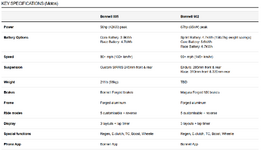
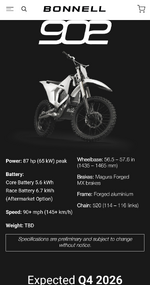
• According to their site, it's supposed to be delivered at the end of 2026.
• It's cool that it has three different swappable batteries. Just keep in mind the weight variation when you modify your suspension setup. By the way, since it seems that they don't offer different setups like soft/medium/hard, they should clarify whether the suspensions are set for the heaviest, the middle or the lightest battery.
• I think it's a very good idea to give the option to have conventionally dimensioned suspensions with Ø 48 mm stenchions and 300+ mm of travel.
• Will it still be cheaper than a Varg with those optional suspensions and the 6.7 kWh battery?
• If the 915 mm seat height readable @ 6:42 in the video is with the shorter travel suspensions, maybe with the bigger ones it will become more full-size like.
• The adjustable rake is quite cool, too. I know of some triple clamps for supermoto that are adjustable, too and AFAIK they don't have reliability problems. Notice that, on Bonnell's site, the wheelbase is stated to be between 1,435 and 1,465 mm, proabably because of the adjustabe rake and maybe because of the optional longer travel suspensions.
• I like the replaceable side panels.
• I also like that the temperatures are shown on the display.
• That multifunction electronic lever on the left side of the handlebars that can be used as a clutch is apparently desired by a lot of riders who want a clutch. They also list a wheelie function on the site.
• The weight really needs to be stated.

 
Logic like that has nothing to do with selling the most powerfull dirtbike in the world. We as enthusiast are a tiny group of the market. Most people don't really understand efficiency etc. They just see the big numbers, and you do want to sell to most people.

- I'm curious about how usefull the battery swaps are. If there is no magic or some real high tech involved. Those battery's will weigh roughly the same as the Vargs. That's 35kg you will be lifting well above seat height. Not that it couldn't be done, but sure us something to consider. Also Stark askes €3-4K for their battery's. I suppose these guys would need to be in the same ballpark. The heavy lifting combined with the hefty price of a battery will restrict how many people will actually do this.
- The Varg MX is also 310mm, the Enduro is 10mm lower.
- Fot the weight of the smaller bike it's very important to consider it's suspension setup and that it's NOT a MX bike. Nothing wrong with playbike category, but people tend to compare them to MX bikes and call MX bikes fat pigs.
- The replaceable side panels are really cool. Kinda what we see on almost every ICE MX/Enduro, it really bothers me Stark doesn't have it.
- That lever is really slick and usefull. Even if just for cruizing and using max regen brake at the rear to conserve as much battery as possible. 2% over an entire ride might add up to 3km pushing, wich is a lott!
- Not only is the adjustable rake cool, it also makes replacing steering stem bearing replacement so much easier.
- I like that every temperature is accesable, however i don't think it should be that big in screen. It's a real geek option and you don't want to seel to just geeks. Most MX riders are simple people in that regard. The standard has been no display at all. I think Stark nailed it with what their display does, just it being a phone is dumb.
 
Allow me to poor a little bit of cold water here 😁

[Grinch mode]
These bikes were introduced last spring, they were supposed to be released in 2025.

They've been pushed back one year, now expected for Q2 and Q4 2026.

Still no weight, still no price. The guy says it will be cheaper than a Varg, yeah, in his shoes I would say the same 😆

It will be good to have some competition for Stark but right now it's little more than a prototype with a good sales pitch.
[/Grinch mode]
 
Allow me to poor a little bit of cold water here 😁

[Grinch mode]
These bikes were introduced last spring, they were supposed to be released in 2025.

They've been pushed back one year, now expected for Q2 and Q4 2026.

Still no weight, still no price. The guy says it will be cheaper than a Varg, yeah, in his shoes I would say the same 😆

It will be good to have some competition for Stark but right now it's little more than a prototype with a good sales pitch.
[/Grinch mode]
Those are only facts.
I'm finding it very hard to get interested in all these "concepts / prototypes / startups" etc.
Even if you would to pour millions into their bank account they would still struggle to deliver on all the promises.

On tangibility scale where:
10 = a bike you can buy, receive in a few weeks and it works in almost every way
0 = a press release
Stark Varg is the only 10
Most others are 1 - 2.
 
Allow me to poor a little bit of cold water here 😁

[Grinch mode]
These bikes were introduced last spring, they were supposed to be released in 2025.

They've been pushed back one year, now expected for Q2 and Q4 2026.

Still no weight, still no price. The guy says it will be cheaper than a Varg, yeah, in his shoes I would say the same 😆

It will be good to have some competition for Stark but right now it's little more than a prototype with a good sales pitch.
[/Grinch mode]
Are these bikes made by Donut? 😁
 
Those are only facts.
I'm finding it very hard to get interested in all these "concepts / prototypes / startups" etc.
Even if you would to pour millions into their bank account they would still struggle to deliver on all the promises.

On tangibility scale where:
10 = a bike you can buy, receive in a few weeks and it works in almost every way
0 = a press release
Stark Varg is the only 10
Most others are 1 - 2.
Yeah I think Dust might be the next "interesting electric dirt bike prototype by a new company " to reach production, probably this year.

Flux seems serious as well, just might take a little bit more time (2027?).

Then of course not a new company but I'm pretty confident EM-Yamaha will start delivering bikes in the next couple of years.

Just don't mention that Honda CR proto to me 🫣
 
Well at least they're working prototypes. So 7/10 maybe?

But i have a hard time imagening them being cheaper than the Stark. Almost everything is build to spec on those bikes. The suspension for example (although maybe good, i don't know), is made by a small novel company. They can never produce at the cost KYB can. The wheels being special is the same. Everything ''espessially made for you my friend'' is expensive.
Also the Starks frame is a very simple steel one. Sure a lott of R&D went into it, but to make it it's cheap as bricks. This 902 aluminium one has many bends and welds. Sure fine if you make 10.000 of the things every month and have welding robots in place. But if you're going to sell maybe a 50 each month that's a lott of specialised labour.

Add to that Stark has +- 1.000 bikes going out of the factory every month and be doing that for a while now. That is scale that brings economics.
Sure a serious part of the Stark price is margin. But the last time i checked that's what keeps company's afloat and Bonnell will need that too.

It's also telling to me we have a weight for the 805, but not for the 902. The 805 has little high end competition so any number under 100kg would be fine. But The 902 has to compete with the Stark and my bet is they have issues getting at the Stark number.
That big Alu box frame will be very heavy compared to the Starks due to not having a fixed battery to support it.

And to have a look at their battery weight:
Going from 5.6 to 4.7kWh they save 7kg. In a video they say it's the same case but with cells removed. So that is just by removing capacity.
Now we don't know the case of the battery. But lets round it to 0kg (wich is hugely in their favour). Sure there will be more nett than gross loss, but i think we're being very generous with the weightless case here.
7kg / 0,9kWh x 5.6kWh = 43.55kg. The Starks 6.5kWh battery wich is a structural part is 35kg.
Lets also not forget that that is the weight you will be lifting above seat height during a ''quick battery swap''.

Looking at the 805 with 96kg again. That has a 3.9kWh battery while that 4.7kWh without even compensating for the smaller case is 7kg lighter. But there you can add another 7kg for even less cells. So we are at 110kg, that's 8kg to go before Stark level. Now comes the bigger housing, the longer and higher frame, stronger motor, the way fatter chain, wider tyres, bigger diameter/longer stroke suspension ect etc. Do you thing that will be done within 8kg? And if by magic so, will it be a number that even matters?

I'm not a weight junky, i could live with a heavier bike with more capacity for sure, but i have a hard time believing this will be under Stark weight. While having a 1.6kWh smaller battery.

I'm also not burning their product here. I think we're looking at cool bikes with some features Stark can learn a thing or 2 about, but we (and them) need to be kinda realistic about it.
And otherwise, well convince me!
 
Well at least they're working prototypes. So 7/10 maybe?

But i have a hard time imagening them being cheaper than the Stark. Almost everything is build to spec on those bikes. The suspension for example (although maybe good, i don't know), is made by a small novel company. They can never produce at the cost KYB can. The wheels being special is the same. Everything ''espessially made for you my friend'' is expensive.
Also the Starks frame is a very simple steel one. Sure a lott of R&D went into it, but to make it it's cheap as bricks. This 902 aluminium one has many bends and welds. Sure fine if you make 10.000 of the things every month and have welding robots in place. But if you're going to sell maybe a 50 each month that's a lott of specialised labour.

Add to that Stark has +- 1.000 bikes going out of the factory every month and be doing that for a while now. That is scale that brings economics.
Sure a serious part of the Stark price is margin. But the last time i checked that's what keeps company's afloat and Bonnell will need that too.

It's also telling to me we have a weight for the 805, but not for the 902. The 805 has little high end competition so any number under 100kg would be fine. But The 902 has to compete with the Stark and my bet is they have issues getting at the Stark number.
That big Alu box frame will be very heavy compared to the Starks due to not having a fixed battery to support it.

And to have a look at their battery weight:
Going from 5.6 to 4.7kWh they save 7kg. In a video they say it's the same case but with cells removed. So that is just by removing capacity.
Now we don't know the case of the battery. But lets round it to 0kg (wich is hugely in their favour). Sure there will be more nett than gross loss, but i think we're being very generous with the weightless case here.
7kg / 0,9kWh x 5.6kWh = 43.55kg. The Starks 6.5kWh battery wich is a structural part is 35kg.
Lets also not forget that that is the weight you will be lifting above seat height during a ''quick battery swap''.

Looking at the 805 with 96kg again. That has a 3.9kWh battery while that 4.7kWh without even compensating for the smaller case is 7kg lighter. But there you can add another 7kg for even less cells. So we are at 110kg, that's 8kg to go before Stark level. Now comes the bigger housing, the longer and higher frame, stronger motor, the way fatter chain, wider tyres, bigger diameter/longer stroke suspension ect etc. Do you thing that will be done within 8kg? And if by magic so, will it be a number that even matters?

I'm not a weight junky, i could live with a heavier bike with more capacity for sure, but i have a hard time believing this will be under Stark weight. While having a 1.6kWh smaller battery.

I'm also not burning their product here. I think we're looking at cool bikes with some features Stark can learn a thing or 2 about, but we (and them) need to be kinda realistic about it.
And otherwise, well convince me!
Not clear if the 17 lbs (7.7 kg) gain claimed by Bonnell in the vid (vid description says 15 lbs) comes from 5.6 kWh core battery to 4.7 kWh sprint battery or from 6.7 kWh race battery to 4.7 kWh sprint battery.

He does say they make the sprint battery by removing cell (and you can't get full power) but doesn't tell where the difference comes between core and race battery.

On the hypothesis of 7.7 kg difference between race and sprint (2 kWh), the cells weight would be

25.8 kg for 6.7 kWh race pack
21.6 kg for 5.6 kWh core pack
18.1 kg for 4.7 kWh sprint pack

With a typical weight around 70 g from 21700 cells, that would make it a 370ish cells pack for 6.7 kWh and 260ish pack for 4.7 kWh.

In cells weight (not taking the case into account), the Bonnell 902 6.7 kWh battery might be about 2 kg lighter than the Varg 7.2 kWh battery that stands at 28 kg in cells (32 kg total with the case).
Just because they would use about 30 less cells.
 
This taken from their website is pretty clear about the ''core'' battery being the standard, otherwise there would have been a ''weight savings'' behind the ''core'' as well. Also them mentioning that being optional made me think about the 5.6 being standard.
I just took the 7kg (15lbs, not 17) from their website.
But since this is more a thought experiment than anything else i would love to run the math were that goes (y)

If the 6,7 racepack is the standard and 4.7 is 7kg's lighter you get even less weight, wich is kind of far fetched i'm afraid, even without the case:
- 23,45kg for 6,7kWh
- 19,6kg for 5,6kWh
- 16,45kg for 4,7kWh

I didn't know the 7,2 from Stark was lighter than the 6,5? The 6.5 is 100% sure 35kg in total.

Still when comming from the 805's 96kg there is at least a 7kg gap if that incluides the race battery (wich i believe is an option and the ''core'' is standard) so you end at 103kg. Still doesn't incluide the casing and all those other things i mentioned above. And with all that to be incluided 15kg still isn't a lott to play with.

1768251069824.png
 
There's at least 4 ways to understand this weight saving thing and extrapolate it to cells weight because informations is so contradictory...

At least they've put a very clear and honest disclaimer on their website

10861.png

Then, their website FAQ still says that bikes are scheduled to be released in 2025 so I'll leave it at that for now !
 
In order to contribute to our mathematical theoretical dream :LOL:, I've investigated to find out the battery voltage for the 902: I've found it for the 4.3 kWh, 46 kW light weight battery, @5:06 in the video in Philip's post #1: 90V nominal. I've noticed that usually the cells used in electric motorcycles, but not only, have a nominal voltage of 3.6V. This means that, since 90 / 3.6 = 25, probably each series of cells have 25 cells. I doubt that the other batteries have different voltages if they work on the same bike, so probably each series have 25 cells, too.
BTW, as far as I've understood, that 90V is bad news because:
• for a performance bike, lower voltage means higher current and therefore more overhearting and less efficiency,
• I guess that using public chargers will be less likely.
 
In order to contribute to our mathematical theoretical dream :LOL:
Well put 😆

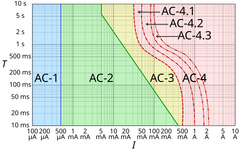
Additionally, perhaps counterintuitively, higher current is more dangerous than high voltage so for a given amount of power it's safer to work with high voltage-low current that low voltage-high current (in a reasonable voltage range, say under 600 V).

1768306379990.png

Assuming 5.0 Ah 21700 cells are used, the smallest battery advertised for the 902, so-called sprint battery at 4.7 kWh, could consist in around 11 parallel sets of series of 25 cells (25s11p). That would be 90 V nominal, 55 Ah, 4.95 kWh.

For comparison the Varg pack is 100s4p: 360 V, 20 Ah, 7.2 kWh.

That would also have an effect on peak power. For instance, assuming 60 A as maximum discharge current (like Molicel P50B), sprint enduro battery could provide 59 kW (80 hp). With the same cells, Varg configuration could theoretically provide 86 kW (117 hp).
 
First running prototypes were assembled a month ago so delivering bikes in a few months will be challenging. Also depends how long they need to fine-tune it before entering production.

They have team in US, Australia and China, they may build the bikes in China to keep the cost down?

CEO and founder Matt Wauters is still listed as Executive director at EBMX so he already got a solid experience in this field (hence the EBMX controller).


When I say that the bikes were quietly pushed back one year, well they claim to have first assembled prototypes in December 2025, meanwhile in April 2025:
"Its bikes are about to hit the US market, with the company stating its units are currently in transit, expected to land stateside by May 2025."


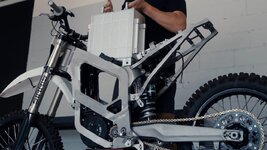
Bonus photo of swappable pack (from April 25 proto)
1768317092143.jpeg
 
Well put 😆

Additionally, perhaps counterintuitively, higher current is more dangerous than high voltage so for a given amount of power it's safer to work with high voltage-low current that low voltage-high current (in a reasonable voltage range, say under 600 V).

View attachment 15782

Assuming 5.0 Ah 21700 cells are used, the smallest battery advertised for the 902, so-called sprint battery at 4.7 kWh, could consist in around 11 parallel sets of series of 25 cells (25s11p). That would be 90 V nominal, 55 Ah, 4.95 kWh.

For comparison the Varg pack is 100s4p: 360 V, 20 Ah, 7.2 kWh.

That would also have an effect on peak power. For instance, assuming 60 A as maximum discharge current (like Molicel P50B), sprint enduro battery could provide 59 kW (80 hp). With the same cells, Varg configuration could theoretically provide 86 kW (117 hp).

Not entirely true. Sure it's the Amps that kill you, but the Voltage is the enabler. I (amps) = U (voltage)/R (ohm).
A human with a dry skin has about 100K - 1000K ohm resistance. That makes for 90/100.000 = 0.0009 A dragging you well into the ''safe zone'' of your graph. Again not entirely correct since you got it for AC, not DC.

NEN3140 (European work standard for elektrical work) regards AC under 50V and DC under 120V as safe to work on/around. It's no coincidence a lott of E bikes keep their max voltage under that.
So to work on for a person it's ''safer'' than working on a Stark, if the amount of protection is the same.

But that low voltage has drawbacks like the higher currents causing higher temperatures and needing thicker cables. Also a tad more fire hazard due to higher temperatures.
For us as riders the big gap is lower voltage bikes being more snappy and a tad less easy to precisely control.
 
First running prototypes were assembled a month ago so delivering bikes in a few months will be challenging. Also depends how long they need to fine-tune it before entering production.

They have team in US, Australia and China, they may build the bikes in China to keep the cost down?

CEO and founder Matt Wauters is still listed as Executive director at EBMX so he already got a solid experience in this field (hence the EBMX controller).


When I say that the bikes were quietly pushed back one year, well they claim to have first assembled prototypes in December 2025, meanwhile in April 2025:
"Its bikes are about to hit the US market, with the company stating its units are currently in transit, expected to land stateside by May 2025."


Bonus photo of swappable pack (from April 25 proto)
I think the problem for them will be finding something that really out performs or out prices or has much better proven reliability than the Varg. If they are just equivalent many customers will be wary of being a test guinea pig all over again as a lot of that has been done for the Varg at this point. Personally I waited for the Varg since I don't have a lot of disposable income to lose

Not all markets are growing either the US market with tariffs and general disinterest in motorcycles probably won't have the growth once hoped for.
 
Not entirely true. Sure it's the Amps that kill you, but the Voltage is the enabler. I (amps) = U (voltage)/R (ohm).
A human with a dry skin has about 100K - 1000K ohm resistance. That makes for 90/100.000 = 0.0009 A dragging you well into the ''safe zone'' of your graph. Again not entirely correct since you got it for AC, not DC.

NEN3140 (European work standard for elektrical work) regards AC under 50V and DC under 120V as safe to work on/around. It's no coincidence a lott of E bikes keep their max voltage under that.
So to work on for a person it's ''safer'' than working on a Stark, if the amount of protection is the same.

But that low voltage has drawbacks like the higher currents causing higher temperatures and needing thicker cables. Also a tad more fire hazard due to higher temperatures.
For us as riders the big gap is lower voltage bikes being more snappy and a tad less easy to precisely control.
Given 2 packs with identical power, don't you think the safer is the one with higher voltage and lower current ?

At a given current, DC is thought to be safer (less damaging) than AC, as illustrated in the norm you mention so it shifts the lines but the tendency remains : lower current is safer.

Another point is that, without any data at all, I've always assumed that there were more e-bikes, play bikes and the like using low voltage because they didn't need high power, resulting in reasonable current.
And that when more powerful bikes started to be developed, they still used low voltage motors for the sake of simplicity: that's what they know, easily available and probably cheaper due to mass production. More high-end motorcycles requiring higher power then used higher voltage for reduced losses, reduced overheating and increased safety keeping current at lower values.
 
Back
Top