
I get Beagle point and its true... But I don't think manufacturing a new battery with practically the same format would be a problem... they could sell it separately and whoever wants it can buy it for their Varg, both for the current one and for the future improved model... Seeing Stark's creative and daring style, it's quite possible they might consider that a good ideaI'm more thinking smaller updates. Apart from the plug all the outer dimensions of 1.0 and 1.2 are the same. Doesn't seem like a huge amount of trouble to keep that the same in upgraded bikes.
This method of new model every year depreciates value fast, making people less likely to just buy the thing when the model is a year old. Because it will be strongly outdated and no longer upgradeable after a few months.
Also imagine having 8 iterations in 10 years for wich you all mandotory need to sell spares in the EU for the first 10 years. Doesn't sound economical.
Beta for example did improve their engines a lott, but a 2013 engine fits in a 2026.
Honda updates their bikes once a century, not every year.

You are using an out of date browser. It may not display this or other websites correctly.
You should upgrade or use an alternative browser.
You should upgrade or use an alternative browser.
Stark Battery Tech Thread
- Thread starter Karinshi
- Start date
A battery with the new 26120 cells cannot have the same format of the 100s4p 21700 battery. The existing packaging space will not accept 2x120mm instead of 2x70mm wide, and given it must be a multiple of 100 cells, it would then probably only be 1p which likely results in a lot less than 7.2kWh.I get Beagle point and its true... But I don't think manufacturing a new battery with practically the same format would be a problem... they could sell it separately and whoever wants it can buy it for their Varg, both for the current one and for the future improved model... Seeing Stark's creative and daring style, it's quite possible they might consider that a good idea
The 120mm cells will likely only be used on the street and adventure bikes (and possibly later other Eicher group bikes), which have a frame wide enough to accept 2x120mm wide instead of the Varg's 2x70mm wide.
I think the point is that 26120 cells more or less fit with current case dimensions with one row instead of two, which is pretty much the point.A battery with the new 26120 cells cannot have the same format of the 100s4p 21700 battery. The existing packaging space will not accept 2x120mm instead of 2x70mm wide, and given it must be a multiple of 100 cells, it would then probably only be 1p which likely results in a lot less than 7.2kWh.
The 120mm cells will likely only be used on the street and adventure bikes (and possibly later other Eicher group bikes), which have a frame wide enough to accept 2x120mm wide instead of the Varg's 2x70mm wide.
Then yes probably 2 rows for adventure bikes, which would still be way better than... '4 rows with 21700! With 4 rows you'd get 2 rows not connected on any side to the case, they'd never get air cooled.
Indeed change from Varg 1.0 to 1.2 is modest, hence why it's 1.2 instead of 2.0.
But I believe whenever they'll upgrade the battery they'll keep their upgraded batteries as close as possible for the entire motorcycle range, that is using same individual cells for all models (like MX1.2, EX and SM), likely in different packs for different applications like 9 kWh Varg and 14-18 kWh adventure bike and so on. It simplifies logistics so much.
It would be super cool from Stark to offer the possibility to upgrade old bikes with new battery (like when they'll switch from 21700 to 26120) but it might not be worth it for them.
My hope is more that if the market grows sufficiently, aftermarket will develop and independent actors will step in to offer their own battery upgrades, refurbishing, conversions and so on. The kind of stuff you can currently do for some electric cars, and of course the huge Surron upgrades aftermarket.
- Likes
- 546
- Location
- Netherlands
But the 1.0 and 1.2 battery's are not interchangable due to the connectors. How stupid is that. Double logistics and "unsatisfied" customers who now cannot spend money on upgrades and are skeptical about buying a 1 year old model.
I just see missed opportunitys here.
Sure if they change an entire frame for the new battery it's something else. But these modest upgrades should be interchangable.
I just see missed opportunitys here.
Sure if they change an entire frame for the new battery it's something else. But these modest upgrades should be interchangable.
Oh I know it's raging.But the 1.0 and 1.2 battery's are not interchangable due to the connectors. How stupid is that. Double logistics and "unsatisfied" customers who now cannot spend money on upgrades and are skeptical about buying a 1 year old model.
I just see missed opportunitys here.
Sure if they change an entire frame for the new battery it's something else. But these modest upgrades should be interchangable.
My guess (and it's just that) is that they had sound reasons to change the connector and that given the choice to solve problems by updating the connector design or sticking to the old design to satisfy first customers (and possibly running into more maintenance issues later on), they chose the first path.
But maybe they could have provided some "conversion" adapter?
It goes further than this, like apparently it's difficult to implement the Varg1.2 software on the 1.0 bike. Which is equally raging and damaging to the brand. It could be related purely to the phone but it could easily be more complex than that. Sometimes new solutions might not be compatible with previous versions... we all know that with software not supported on older systems, it's annoying... but that's just the way it is, backwards compatibility is not always possible, especially when systems evolve fast.
No one will go to a car dealership asking them to swap the battery pack for the more recent version, the tech will keep improving but you're pretty much stuck with what you bought... until you change your car.
I know it COULD be simpler with motorcycles, it probably SHOULD, I doubt it WILL.
I agree, I'd like to upgrade my battery in five years and have 50% more capa at minimal weight gain. Yet, I'm not sure that works. Let me explain:I think the point is that 26120 cells more or less fit with current case dimensions with one row instead of two, which is pretty much the point.
Then yes probably 2 rows for adventure bikes, which would still be way better than... '4 rows with 21700! With 4 rows you'd get 2 rows not connected on any side to the case, they'd never get air cooled.
Indeed change from Varg 1.0 to 1.2 is modest, hence why it's 1.2 instead of 2.0.
But I believe whenever they'll upgrade the battery they'll keep their upgraded batteries as close as possible for the entire motorcycle range, that is using same individual cells for all models (like MX1.2, EX and SM), likely in different packs for different applications like 9 kWh Varg and 14-18 kWh adventure bike and so on. It simplifies logistics so much.
It would be super cool from Stark to offer the possibility to upgrade old bikes with new battery (like when they'll switch from 21700 to 26120) but it might not be worth it for them.
My hope is more that if the market grows sufficiently, aftermarket will develop and independent actors will step in to offer their own battery upgrades, refurbishing, conversions and so on. The kind of stuff you can currently do for some electric cars, and of course the huge Surron upgrades aftermarket.
- the current battery housing is packaged into the Varg frame
- it can't get wider than that, but it may be smaller
- inside are 400 cells (100s4p), and they are distributed into two halves of the case:
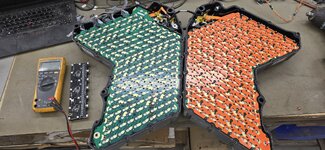
pic borrowed from here
- 200 on the left, 200 on the right, each 70mm wide and ø21 with two PCBs and isolation between them (=140mm + x)
- filling it with more cells 120mm wide + one PCB + one isolation (= 120mm +x/2) in y-direction
- the packaging for 200 cells ø21 won't allow for 200 cells ø26 in x-z-direction
At the same time, the 26120 cells of course have more capa than one 21700 cells - but not enough to replace four of them. Looking at the quoted energy density from earlier in this thread, the arrangement of just 100x 26120 cells would have around 5kWh.
There's probably enough engineering freedom to add some more 26120 cells, but it won't break the 200 qty in the Varg architecture - a new Varg architecture with frame packaging and battery position adjusted might break the 200 cell threshold, or even the 300 cell threshold.
Edited to wrap up: we very likely won't see a 26120 battery in the Varg 1.2 architecture as a retro-fit.
Right, new form factor allows complete redesign of the pack, which is the point, to improve cooling and so on.
I am not sure they've mentioned any electrical characteristics like cell voltage? A 26120 pack may not be compatible with the current hardware.
Anyway, from simple geometry, about 150 26120 cells represent a similar volume to the current pack of 400 21700 cells. We don't know the volumetric energy density (they did mention aiming for gravimetric energy density of 330 Wh/kg) but one can expect that volumetric density would also improve so a 150ish-cells pack should carry more energy.
For similar capacity, a 100-120ish pack might be enough but not sure they'd go this way for a future Varg (IMHO it would make more sense to improve capacity rather than to reduce weight or volume at the moment).
As always, thanks for the stimulating conversation, I love it here!
I am not sure they've mentioned any electrical characteristics like cell voltage? A 26120 pack may not be compatible with the current hardware.
Anyway, from simple geometry, about 150 26120 cells represent a similar volume to the current pack of 400 21700 cells. We don't know the volumetric energy density (they did mention aiming for gravimetric energy density of 330 Wh/kg) but one can expect that volumetric density would also improve so a 150ish-cells pack should carry more energy.
For similar capacity, a 100-120ish pack might be enough but not sure they'd go this way for a future Varg (IMHO it would make more sense to improve capacity rather than to reduce weight or volume at the moment).
As always, thanks for the stimulating conversation, I love it here!



Nice conversation; i dont care how they do it, if they change cells, formfactor, shape... IMHO we all need the same weight but with 360wh/kg so we can reach 10kwh, for me it can stay like that for 10 years that i won't care... right now range for me is not bad but i just want that little extra bit more and i will be more than happy
- Likes
- 546
- Location
- Netherlands
I've once calculated that 1kWh is roughly 0,6L (efficiency etc taken into account). Most Enduro bikes have 9,5L. So roughly 15,8kWh is the proper replacement.
thats the equivalent to 565wh/kg density with the same weight, i think we are at a minimun of a decade away from thatI've once calculated that 1kWh is roughly 0,6L (efficiency etc taken into account). Most Enduro bikes have 9,5L. So roughly 15,8kWh is the proper replacement.


- Likes
- 546
- Location
- Netherlands
Well that calculation of mine was with streetbikes now that i think of it. Might be better with Offroading espescially since the speeds (and thus wind resiatance) are lower and there is a lott more on-off throttle going on.thats the equivalent to 565wh/kg density with the same weight, i think we are at a minimun of a decade away from that
The Stark EX has some life in it after most of our OTR events (some it will never make it to the finish). Our 9,5L bikes can mostly do 2 laps with a little gas left. So 14,4 seems to be the replacement there. In wich the math kinda lines up since all are very rough estimates.
I could live with a heavier Stark though. If their next model is 10kWh due to better battery then the battery x 1,5 (35 x 1,5 = 52,5) adds 17,5kg the bike ends up at 137,5 kg. Wich is kinda at the end of what is fun on an ICE at these events. But E's do have way of making weight dissappear. I guess they would feel roughly the same as the 450's out here.
By then if it's fast charge you will also have made a KTM 690 killer wich would be a serious extention of potential customers.
Come to think of it. Such a bike would allow for a seperate MX bike in the stable...
Agreed, I think around 500 Wh/kg is the tipping point (for motorcycles).
30 kg battery would then deliver 15 kWh, giving plenty of range, almost on par with combustion motorcycles (heavy 15 kWh Zero motorcycles have well over 200 km range).
That is a tall order, roughly doubling the current materials performance. It could be 15 years from now if you're pessimistic, 5 years if you're very optimistic but 500 Wh/kg is the sweet spot.
30 kg battery would then deliver 15 kWh, giving plenty of range, almost on par with combustion motorcycles (heavy 15 kWh Zero motorcycles have well over 200 km range).
That is a tall order, roughly doubling the current materials performance. It could be 15 years from now if you're pessimistic, 5 years if you're very optimistic but 500 Wh/kg is the sweet spot.
- Likes
- 546
- Location
- Netherlands
Spirited riding gives 10 km/kWh.Agreed, I think around 500 Wh/kg is the tipping point (for motorcycles).
30 kg battery would then deliver 15 kWh, giving plenty of range, almost on par with combustion motorcycles (heavy 15 kWh Zero motorcycles have well over 200 km range).
That is a tall order, roughly doubling the current materials performance. It could be 15 years from now if you're pessimistic, 5 years if you're very optimistic but 500 Wh/kg is the sweet spot.
The big problem with Zero is their lack of fast charging. If you want to achieve acceptance the charging should be well within fuel and smoke break of the buddies.
Johnny Depp
Well-known member
- Likes
- 212
- Location
- Austin TX
Personally, I've already got plenty of power and range for my needs. IMO there's a niche for lighter and less expensive, with a quick swap.they are at full capacity now on EX and SM production... there are delays again like at the first days
i think they are Happy with sales...
a Next gen Varg will be very wanted on the market, the most important update is the battery capacity... with the new colab with A123 i think is possible to reach 360wh/kg and with the same weight and size we can reach 10kw/h battery
lets see if Anton says anything on this matters on the Q/A on thursday
they are struggling with 360wh/kg i can imagine 500... plus all the safety testing and all the other measures for correct functionality (heat management, degradation, quick discharge and charge etc...)Agreed, I think around 500 Wh/kg is the tipping point (for motorcycles).
30 kg battery would then deliver 15 kWh, giving plenty of range, almost on par with combustion motorcycles (heavy 15 kWh Zero motorcycles have well over 200 km range).
That is a tall order, roughly doubling the current materials performance. It could be 15 years from now if you're pessimistic, 5 years if you're very optimistic but 500 Wh/kg is the sweet spot.
jcozine
Member
- Likes
- 17
- Location
- Los Angeles
Having worked for 3 different E-moto startups out here on the US west coast I can say all of these companies are trying to crack the fast charging spell. All 3 of mine were involved with cell suppliers of varying levels of credibility. Liars, liars, battery suppliers, as they say. The smart startups don't tie their fortunes to any one of them actually coming through.
I had high hopes Stark would have fast charging coming soon since they started with a HV architecture which should theoretically unlock Level 3 charging without the heavy OBC, but have so far been disappointed. Getting heat out of the battery without liquid cooling or phase change material is a tough ask, and both of those technologies come with a significant weight and cost penalty, so I can see why they haven't yet for the MX bikes.
But it makes sense Stark is going after it again though as they transition into street bikes - @Erwin P is totally right that a smoke-break recharge is what unlocks widespread adoption in the high-end market. Swappable batteries is an interesting concept that Gogoro for example is scaling for scooters in Taiwan semi-successfully, but it comes with the tradeoff that you need a critical mass of people buying your product for the eco-system of battery stations to make commercial sense, and for every 3-4 bikes you sell you have to make another battery to just sit there at the station. Surrons are another good counter argument of just swapping at the consumer level, but they also show the tradeoffs involved in not making your battery a structural member - everything gets wider, fatter, heavier - not great for a high end performance product, and definitely not great for getting further away from home.
I had high hopes Stark would have fast charging coming soon since they started with a HV architecture which should theoretically unlock Level 3 charging without the heavy OBC, but have so far been disappointed. Getting heat out of the battery without liquid cooling or phase change material is a tough ask, and both of those technologies come with a significant weight and cost penalty, so I can see why they haven't yet for the MX bikes.
But it makes sense Stark is going after it again though as they transition into street bikes - @Erwin P is totally right that a smoke-break recharge is what unlocks widespread adoption in the high-end market. Swappable batteries is an interesting concept that Gogoro for example is scaling for scooters in Taiwan semi-successfully, but it comes with the tradeoff that you need a critical mass of people buying your product for the eco-system of battery stations to make commercial sense, and for every 3-4 bikes you sell you have to make another battery to just sit there at the station. Surrons are another good counter argument of just swapping at the consumer level, but they also show the tradeoffs involved in not making your battery a structural member - everything gets wider, fatter, heavier - not great for a high end performance product, and definitely not great for getting further away from home.
I don't see fast charging as much of a technical hurdle as reaching energy density in the 500s Wh/kg?
After all, commercial 21700 cells like Molicel P50B released in 2024 was already rated 5C allowing 15ish min charging.
Of course it would degrade cycle life but we're really close from that not being a concern anymore: P50B is rated at 750 (5C/-1C) cycles for 80% retention, CATL just unveiled a 5C cell rated for 3000 cycles at 80% retention (not many details nor any release date yet).
In this coffee break charging goal, I believe the real hurdle is charging infrastructure. And here the limitation comes from your government rather than the technology.
After all, commercial 21700 cells like Molicel P50B released in 2024 was already rated 5C allowing 15ish min charging.
Of course it would degrade cycle life but we're really close from that not being a concern anymore: P50B is rated at 750 (5C/-1C) cycles for 80% retention, CATL just unveiled a 5C cell rated for 3000 cycles at 80% retention (not many details nor any release date yet).
In this coffee break charging goal, I believe the real hurdle is charging infrastructure. And here the limitation comes from your government rather than the technology.
Similar threads
- Replies
- 4
- Views
- 2,070